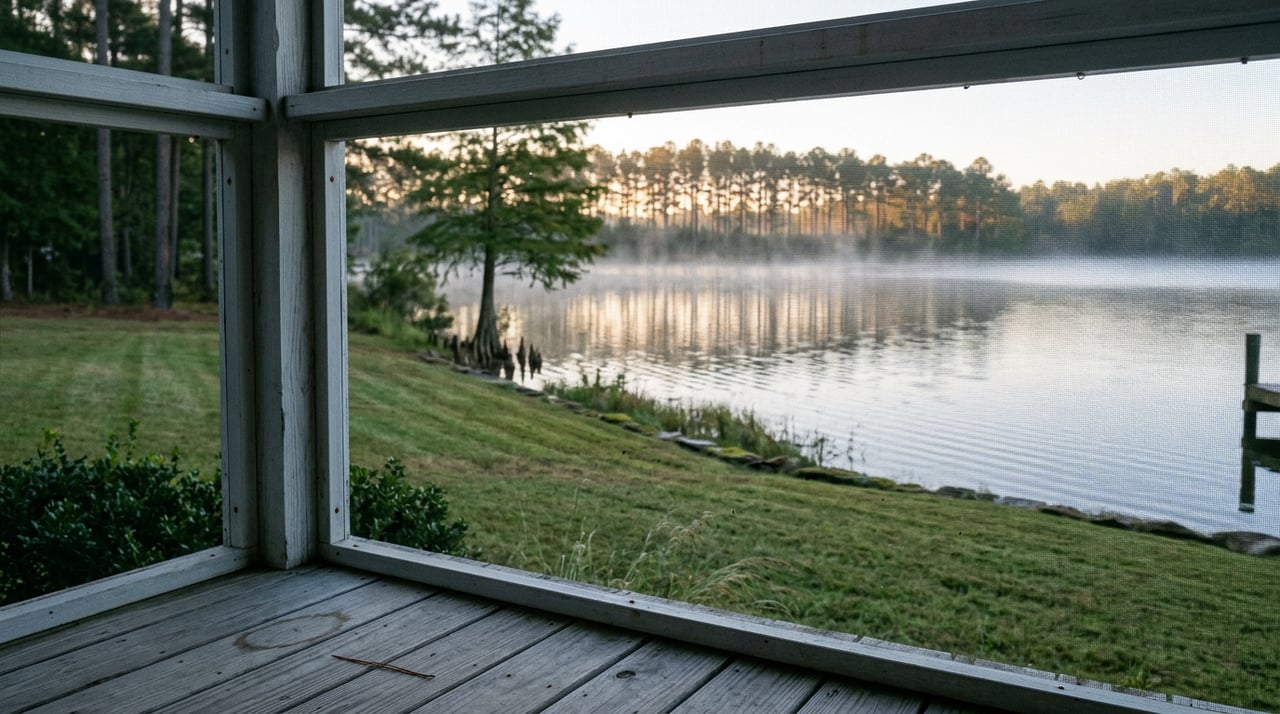
The Thagard Dam Is Being Rebuilt. The Village's Own Numbers Haven't Caught Up.
August 13, 2026
August 13, 2026
"Use of Thagard Lake will not be impacted by the drawdown."
That was the Village of Whispering Pines' message in April 2024, after a routine dam inspection turned up two spots worth a closer look. Staff lowered the lake about 12 inches below the spillway lip, brought in an underwater drone and a dive team, and got their answers. Paddlers kept paddling. Boats kept launching. The small drawdown came and went, noticed mostly by the residents who were already paying attention.
That was the easy version of dam work. The real project, the one that will eventually replace Thagard Dam itself, is a different scale of undertaking, and if you're going by what's still posted on the Village's own website, you're working from numbers that are already behind where the project actually stands.
Thagard Dam wasn't built once. It went up in four separate sections between 1900 and 1964, stitched together across six decades before dam safety was a formal state program. Today it holds back Thagard Lake, 209 acres of water and the largest of the ten lakes, ponds, and dams the Village owns, impounding more than 103 million gallons behind a structure older than most of the houses around it.
North Carolina's Dam Safety program classifies Thagard Dam as High Hazard. The Village's own engineering reviews have flagged specific problems behind that classification: seepage where the dam meets rock outcrops, cracking and leakage through both the primary and secondary spillways, and concern about internal deterioration of the concrete itself, the kind of slow chemical breakdown known as Alkali-Silica Reaction. Weigh those findings against the cost of continuing to chase repairs on a structure already more than 80 years old in places, and the Village concluded that a new dam made more sense than patching the old one indefinitely.
Here's where it matters for anyone who lives near the water. The Village's Frequently Asked Questions page, still live as of this writing, lays out a project built around an earlier round of estimates. A Sandhills Sentinel report published June 12, 2026, just weeks before this was written, describes a project that looks meaningfully bigger.
| Village FAQ (as posted) | Sandhills Sentinel, June 2026 | |
|---|---|---|
| Estimated construction cost | $8 to $12 million | More than $20 million |
| Construction start | January 2027 | Potentially as early as 2028 |
| Spillway | Not yet finalized | New labyrinth-style design |
| Lake level during construction | Likely lowered at some point, not before January 2027 | Lake to be temporarily drained |
Neither figure is exactly wrong. The FAQ page was written around a design that hadn't cleared NC Dam Safety review yet, and it says as much. The Sentinel's number reflects a project that's moved further through design, with a specific spillway type chosen and a fuller cost picture attached. But if you're a resident planning around the Village's posted timeline, you're currently reading numbers that are close to a year and several million dollars behind the project's actual trajectory.
The Village went after federal help almost immediately. Its consulting engineer, WithersRavenel, submitted a funding request through North Carolina's Dam Safety Program for FEMA's High-Hazard Potential Dam Grant Program, which can cover up to 65 percent of an eligible project's cost, with the local government responsible for the remaining 35 percent. By August 2024, the Village's website was reporting that FEMA had awarded just over $9.5 million to the NC Department of Environmental Quality, the state agency distributing the money, though a final award notification timeline for individual applicants like Whispering Pines was still undetermined. The following month, the Village's manager's report put the state's take at $9.3 million against a $14.5 million statewide request, meaning not every dam project that applied would get funded, and noted that Whispering Pines was still in the running even as other applicants had already been turned down.
Whatever the federal share ends up being, the Village isn't waiting on it to build its own cushion. Ten cents of every $100 in assessed property value goes automatically into a Capital Reserve Major Repair Fund set aside for large capital projects like this one. As of July 1, 2025, the Village estimated it had $3.29 million available in that fund, with more revenue expected through the current fiscal year and a projected balance topping $4 million by January 2028, which happens to line up with when construction is now expected to begin.
Whispering Pines has already shown it can lower a lake without shutting down the neighborhood around it. The April 2024 inspection at Thagard, the one that opened this piece, is one example. A second comes from a different lake entirely. As of a Village Council packet from August 2025, Spring Valley Dam was going through its own spillway repair, with a target of finishing by February 2026 so the water level would have the rest of spring to recover before warm weather returned.
That context is useful, but it isn't a preview of what's coming at Thagard. A 12-inch drawdown for an inspection and a spillway patch on a smaller dam are maintenance. Draining Thagard Lake to rebuild the dam behind it is a multi-year construction project on the Village's largest body of water, and the Village's newer language describes that as a temporary full drain rather than a partial one.
A few things are worth holding onto amid the moving numbers. The Village has said it does not anticipate the project affecting residents' use of Thagard Lake Park at 12 S. Lakeshore Drive, though that answer is explicitly subject to change once construction actually starts. And no matter how the project ends up funded, whether that's FEMA money, state assistance, or a Village loan, accepting grant funding does not change who gets to use the lakes and parks. Village-owned water in Whispering Pines stays reserved for residents, property owners, and Village employees, the same as it is today.
The project is still moving through design, and the Village has said its own timeline estimates remain subject to change as engineering work progresses. If you want to track it as it develops, the Village posts updates directly to its Thagard Lake Dam Replacement page, Council work session packets are archived on the Village site ahead of and after each meeting (the August 2025 packet covering the Spring Valley repairs is one example), and The Pitch Magazine, the community's own monthly publication, covers Village government proceedings alongside the usual club and school news. Sandhills Sentinel has also been following the story closely.
For anyone whose dock, boat storage, or lake days depend on knowing what's actually coming, those sources are a better bet than assuming the number on the FAQ page is still the number that matters.
This kind of project, one that touches dock access, boat storage, and how a lake feels for a few construction seasons, tends to move quietly until it doesn't. If you own on Thagard Lake, or you just keep half an eye on Village business, it helps to check the Council packets rather than lean on the FAQ page alone. If you have questions about how any of this might affect a property you own in Whispering Pines, or you're simply trying to make sense of what's ahead for the lake, I'm glad to talk it through.
Ross Laton, Let's Connect.
Stay up to date on the latest real estate trends.

With deep roots in Seven Lakes and a passion for helping clients make confident real estate decisions, Ross Laton offers local insight, personalized service, and a seamless experience from start to finish.
SEVEN LAKES REAL ESTATE
103 Fawn Court West End, NC 27376 MON - SAT 8:00AM - 7:00PM SUN 1:00PM - 5:00PM